
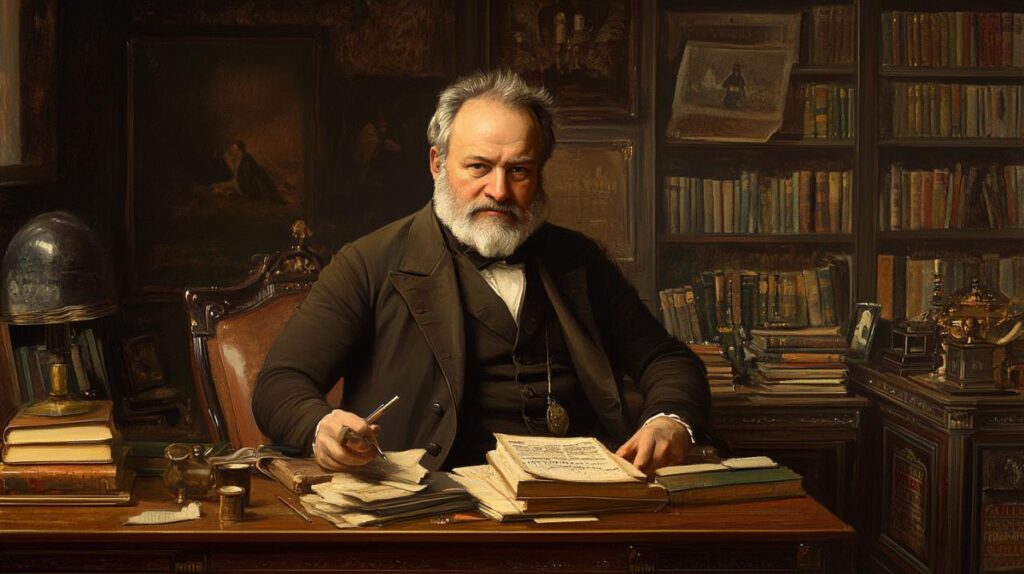
Victor Hugo's years of exile on the island of Guernsey were not merely a period of political retreat but a profound transformation of his creative vision. From 1856 to 1870, the French writer inhabited Hauteville House, a residence that would become far more than a dwelling. This refuge, perched in Saint Peter Port, allowed Hugo to see the distant northern coast of France from its belvedere, a daily reminder of the homeland from which he had been banished. The house itself, adorned and arranged by Hugo's own hand, became a canvas upon which he projected his ideals, his grief, and his unyielding opposition to Napoleon III. Within its walls, he completed some of his most celebrated works, including Les Misérables, and forged a new symbolic language that would permeate his later publications.
The Architecture of Isolation: Hauteville House as Hugo's Creative Sanctuary
From Parisian Boulevards to Guernsey Shores: The Political Circumstances of Hugo's Departure
The political upheaval that swept through France in the mid-nineteenth century forced many thinkers and writers into exile, and Victor Hugo was among the most prominent. His vocal opposition to the authoritarian regime of Napoleon III, who had seized power in a coup and subsequently declared himself emperor, made Paris untenable for the celebrated novelist and dramatist. Hugo refused to return to France until political freedom was restored, a stance that would keep him on Guernsey for over a decade. This was not a passive retreat but an active political statement, a refusal to compromise his principles even in the face of personal hardship. The Channel Islands, though geographically close to France, offered a safe haven where Hugo could continue his work and his resistance. The choice to settle in Guernsey was both practical and symbolic, a place from which he could observe his homeland while remaining beyond the reach of its government.
The Physical and Psychological Landscape of Hauteville House: A Refuge Transformed into a Symbol
Hauteville House stands as a remarkable testament to Hugo's vision and creativity. The five-storey residence, which he purchased in 1856 with proceeds from his book of poems Les Contemplations, was the only property Hugo ever owned, as he had previously rented accommodations in Paris. From the moment he acquired it, Hugo set about transforming the house into a personal and artistic statement. He employed local craftsmen and incorporated items such as Chinese tapestries, creating an interior that was both eclectic and deeply meaningful. Each room was imbued with symbolic decor, including inscriptions bearing the names of figures such as Luther, Christ, Shakespeare, and Dante, reflecting Hugo's intellectual and spiritual influences. The dining room, for instance, features the carved inscription Exilium Vita Est, which may be interpreted as exile is life, a poignant reminder of his circumstances and his philosophical acceptance of them. From 1862, Hugo hosted monthly meals in this room for poor children, an act of charity that underscored his commitment to social justice even while in exile. The belvedere at the top of the house offered a panoramic view of the sea and, on clear days, the coast of France, a vista that must have stirred both longing and resolve in the writer's heart.
Exile's Imprint on Literary Imagery: Symbolism in Hugo's Post-1851 Works
Maritime Metaphors and Island Consciousness in The Inner Voices and Later Poetry
The experience of living on an island, surrounded by the restless waters of the English Channel, profoundly influenced Hugo's use of maritime imagery in his later works. The sea became a recurring motif, representing both isolation and connection, the vast expanse that separated him from France yet linked him to the broader world. In his poetry, particularly in collections written during his time at Hauteville House, the ocean serves as a metaphor for exile, resilience, and the eternal struggle between freedom and oppression. Les Contemplations, the volume that financed his purchase of Hauteville House, was itself a meditation on loss and memory, compelled by the unexpected death of his daughter Léopoldine at the age of nineteen. This personal tragedy infused his later writing with a depth of emotion and a preoccupation with themes of mortality, the passage of time, and the search for meaning in suffering. The island consciousness that permeated his daily life also found expression in his novels, where characters often find themselves on the margins of society, navigating treacherous moral and physical landscapes.

The Hauteville Effect on Dramatic Works: Rethinking Space and Power in Theatre
While Hugo is perhaps best known for his novels, his contributions to theatre were also significant, and his years in Guernsey allowed him to reconsider the relationship between space and power in his dramatic works. The physical isolation of Hauteville House, with its carefully curated rooms and symbolic interiors, may have influenced his thinking about how settings shape narrative and character. In plays such as Ruy Blas, Marion Delorme, and Angelo, Tyrant of Padua, Hugo had already explored themes of political intrigue, social hierarchy, and the tension between public duty and private desire. The experience of exile deepened his understanding of how environments constrain or liberate individuals. The house itself became a kind of stage, with each room serving a distinct purpose and reflecting different facets of Hugo's identity as a writer, a political activist, and a family man. This architectural theatre of the self may have reinforced his belief in the power of physical space to reveal psychological truths, a concept that would resonate through his later dramatic and narrative works. The renovation of Hauteville House between 2017 and 2019, supported by the Pinault Collection Foundation, has ensured that visitors can still experience this unique intersection of literature and lived space.
Family, Solitude, and the Writer's Craft: Personal Life at Hauteville House
Domestic Dynamics: Adèle Foucher, Juliette Drouet, and the Emotional Geography of Exile
Hugo's domestic life at Hauteville House was complex, shaped by the presence and absence of key figures in his personal history. His wife, Adèle Foucher, joined him in Guernsey, though their relationship had long been strained by his numerous affairs and by the shared grief over the loss of their daughter Léopoldine. Juliette Drouet, Hugo's devoted mistress and companion, was a constant presence during his exile, living nearby and providing emotional support and companionship. The emotional geography of the house reflected these tangled relationships, with different spaces serving as refuges for solitude, creativity, and domestic interaction. The studio, where Hugo wrote works such as L'Homme qui Rit and part of La Légende des Siècles, was a sanctuary of intense focus and literary productivity. The house's decorative elements and inscriptions suggest a man grappling with his identity, his legacy, and his place in the world, all while navigating the delicate dynamics of family and love.
Legacy and Loss: Charles, François-Victor, and Adèle Hugo Within the Walls of Hauteville
The presence of Hugo's children during his exile added further layers of meaning to life at Hauteville House. His sons, Charles and François-Victor, were both writers and translators, contributing to the intellectual atmosphere of the household. François-Victor, in particular, undertook the monumental task of translating Shakespeare's complete works into French during this period, a project that resonated with Hugo's own reverence for the English playwright, whose name was inscribed in the house's symbolic decor. Hugo's daughter Adèle, whose tragic mental decline would later overshadow the family's history, also spent time in Guernsey, though her struggles with mental illness became more pronounced in the years that followed. The house, with its five levels and carefully arranged rooms such as the Billiard Room, Tapestry Room, Red Room, Blue Room, Oak Gallery, and the Look-Out, bore witness to moments of familial solidarity and profound personal sorrow. Hugo left Guernsey on the fifth of August in 1870, following the fall of Napoleon III and the restoration of political freedoms in France, but he returned to the island three times thereafter. His longest visit occurred between 1872 and 1873, and his final sojourn lasted from the fifth of July to the ninth of November in 1878. These returns suggest that Hauteville House had become more than a place of exile; it was a home imbued with memory, creativity, and the enduring ties of family and loss. In 1927, Hugo's grandchildren gifted the house to the City of Paris, ensuring its preservation as a monument to his life and work. Today, Hauteville House operates as a museum, offering guided tours that allow visitors to explore the rooms where one of France's greatest writers crafted his most enduring works. The house stands as a testament to the power of place in shaping artistic vision, a symbol of resilience, and a window into the complex inner life of Victor Hugo.
